

eLearning Training Course
About the project
For the Advanced Instructional Design course in my Educational Technology Program, three classmates and I were tasked with developing an eLearning product for an actual client, the University of Arkansas IT department. The department needed a FERPA training course for its help desk and computer lab employees.
With our instructor, Dr. Cheryl Murphy, serving as our project manager, we worked with Shelly Walters, the Associate Director of Instructional Design and Support Services, and Travis Lynch, the Computer Lab and Student Tech Center Supervisor and Operations Manager, to complete the project during the Spring 2017 semester.
We developed the training in Articulate Storyline and incorporated an animated branching scenario using Go Animate (now Vyond).
Click on the image below to open the interactive FERPA Compliance Training.
Course Design Process
Select the tabs below to learn more about the process we followed to complete this project and to see some of the documentation we produced along the way.
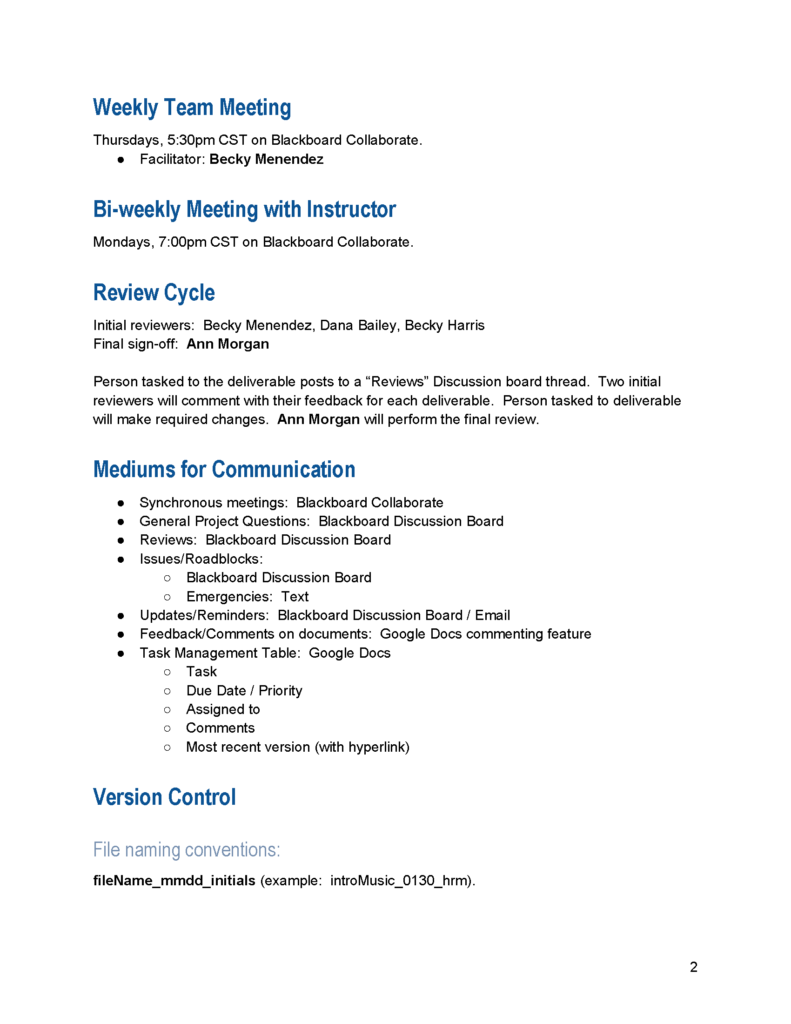
The first task we completed was the development of a team communication plan. In this plan, we documented how and when status reports would be provided to our project manager; how and when team meetings would be conducted; what our procedures would be for the review of deliverables; what mediums we would use for different types of communications; how we would approach file sharing, storage, organization, security, and version control; and how we would track time contributions to the project.
Additionally, we identified the roles that each team member would take in key tasks. While some of our initial decisions had to be adapted as the project unfolded, completing this communication plan early on helped ensure that our team had clear roles, communication channels, and procedures moving forward.
Next, the team met with our clients to clarify the goals of the training and to begin developing a detailed design plan. We gathered information about the training needs, the learners, the learning environment, and the platform that would be used to deliver the training. We identified measurable learning objectives, instructional strategies, assessment strategies, and supporting content. We made decisions regarding media as well as the look and functionality of the training interface. All this information was documented in the design plan and presented to our clients for approval.
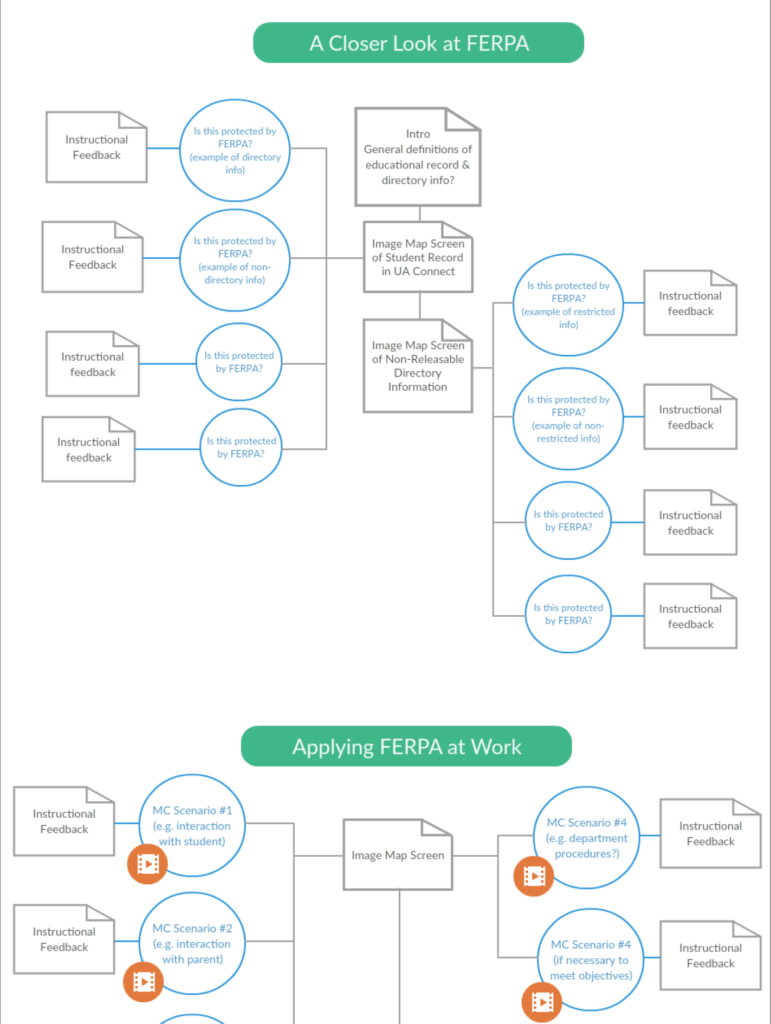
After receiving approval for our design plan, we started off the development phase by creating a flowchart of the proposed course for our clients, which visually depicted the learning paths students could take to complete the course. We also designed several prototype slides for the clients to help us finalize decisions related to color scheme and slide layouts.
Once our flowchart and prototypes were approved, we began developing the content – writing slide text, selecting images, writing scripts, and creating narrated animation videos. These elements were then brought into Articulate Storyline, and I applied the programming needed to support our interface features, the score tally, the branching scenarios, learner feedback, and closed captioning.
To help the team manage the multiple tasks (and often, dependencies) involved in the development phase, I created and maintained a Gannt chart. which we used to assign tasks and establish timelines.
Once the development of the Articulate project was complete, it was published as a SCORM package and set up in Blackboard for an internal beta review as well as a usability test with volunteer participants. The feedback obtained from these evaluation instruments was used to revise the project, and a final package was prepared for our clients.
Although the class ended before we could see the results of its implementation, we were happy to receive positive feedback from our client on the final product. Although Shelly was unable to attend our final presentation, Travis indicated that our training product exceeded his expectations and that he learned a lot from engaging in the process with us.